

Astrology Tools
Explore free astrology reference guides to look up Western zodiac sign dates, classical elements, and traditional Chinese lunar calendar animal years.
| Tool | Category | Description | Action |
|---|---|---|---|
|
Aquarius Zodiac Sign Info
Reference page for Aquarius (Jan 20 – Feb 18) covering pe...
|
Astrology Tools | Reference page for Aquarius (Jan 20 – Feb 18) covering personality traits, element, rul... | Open |
|
Aries Zodiac Sign Info
Interactive reference page for the Aries zodiac sign cove...
|
Astrology Tools | Interactive reference page for the Aries zodiac sign covering dates, personality traits... | Open |
|
Cancer Zodiac Sign Info
Displays detailed information about the Cancer zodiac sig...
|
Astrology Tools | Displays detailed information about the Cancer zodiac sign including dates, traits, com... | Open |
|
Capricorn Zodiac Sign Info
Static reference page for the Capricorn zodiac sign (Dec ...
|
Astrology Tools | Static reference page for the Capricorn zodiac sign (Dec 22 – Jan 19) — dates, symbol, ... | Open |
|
Gemini Zodiac Sign Info
Interactive reference page for the Gemini zodiac sign — d...
|
Astrology Tools | Interactive reference page for the Gemini zodiac sign — dates, personality traits, comp... | Open |
|
Leo Zodiac Sign Info
Reference page for the Leo zodiac sign (July 23 – August ...
|
Astrology Tools | Reference page for the Leo zodiac sign (July 23 – August 22) covering personality trait... | Open |
|
Libra Zodiac Sign Info
Comprehensive reference page for the Libra zodiac sign (S...
|
Astrology Tools | Comprehensive reference page for the Libra zodiac sign (Sep 23 – Oct 22) with traits, c... | Open |
|
Pisces Zodiac Sign Info
Reference page for Pisces (Feb 19 – Mar 20) covering pers...
|
Astrology Tools | Reference page for Pisces (Feb 19 – Mar 20) covering personality traits, element, rulin... | Open |
|
Sagittarius Zodiac Sign Info
Interactive reference page for the Sagittarius zodiac sig...
|
Astrology Tools | Interactive reference page for the Sagittarius zodiac sign covering dates, personality ... | Open |
|
Scorpio Zodiac Sign Info
Comprehensive reference page for the Scorpio zodiac sign ...
|
Astrology Tools | Comprehensive reference page for the Scorpio zodiac sign (October 23 – November 21) cov... | Open |
|
Taurus Zodiac Sign Info
Displays comprehensive information about the Taurus zodia...
|
Astrology Tools | Displays comprehensive information about the Taurus zodiac sign including dates, traits... | Open |
|
Virgo Zodiac Sign Info
Comprehensive reference page for the Virgo zodiac sign (A...
|
Astrology Tools | Comprehensive reference page for the Virgo zodiac sign (Aug 23 – Sep 22) with traits, c... | Open |
|
Year of the Dog Info
Displays personality traits, compatibility, lucky numbers...
|
Astrology Tools | Displays personality traits, compatibility, lucky numbers/colors, and a list of Dog yea... | Open |
|
Year of the Dragon Info
Displays personality traits, compatibility, lucky numbers...
|
Astrology Tools | Displays personality traits, compatibility, lucky numbers/colors, and a list of Dragon ... | Open |
|
Year of the Goat Info
Reference page for the Chinese Zodiac Goat sign — birth y...
|
Astrology Tools | Reference page for the Chinese Zodiac Goat sign — birth years, personality traits, comp... | Open |
|
Year of the Horse — Chinese Zodiac
Informational page about the Chinese Zodiac Horse sign: b...
|
Astrology Tools | Informational page about the Chinese Zodiac Horse sign: birth years, personality traits... | Open |
|
Year of the Monkey Info
Reference page for the Chinese Zodiac Monkey sign — perso...
|
Astrology Tools | Reference page for the Chinese Zodiac Monkey sign — personality traits, lucky numbers, ... | Open |
|
Year of the Ox Info
Reference page for the Chinese Zodiac Ox sign — personali...
|
Astrology Tools | Reference page for the Chinese Zodiac Ox sign — personality traits, lucky numbers/color... | Open |
|
Year of the Pig — Chinese Zodiac
Informational reference page for the Pig sign in the Chin...
|
Astrology Tools | Informational reference page for the Pig sign in the Chinese zodiac: personality traits... | Open |
|
Year of the Rabbit Info
Reference page for the Chinese Zodiac Rabbit sign — perso...
|
Astrology Tools | Reference page for the Chinese Zodiac Rabbit sign — personality traits, lucky numbers, ... | Open |
|
Year of the Rat Info
Reference page for the Chinese Zodiac Rat sign — personal...
|
Astrology Tools | Reference page for the Chinese Zodiac Rat sign — personality traits, lucky numbers/colo... | Open |
|
Year of the Rooster Info
Displays personality traits, compatibility, lucky numbers...
|
Astrology Tools | Displays personality traits, compatibility, lucky numbers/colors, and a list of Rooster... | Open |
|
Year of the Snake Info
Comprehensive Chinese Zodiac Snake sign guide with person...
|
Astrology Tools | Comprehensive Chinese Zodiac Snake sign guide with personality traits, compatibility, l... | Open |
|
Year of the Tiger — Chinese Zodiac Info
Reference page for the Chinese Zodiac Tiger sign — person...
|
Astrology Tools | Reference page for the Chinese Zodiac Tiger sign — personality traits, lucky numbers/co... | Open |
Most popular in Astrology Tools
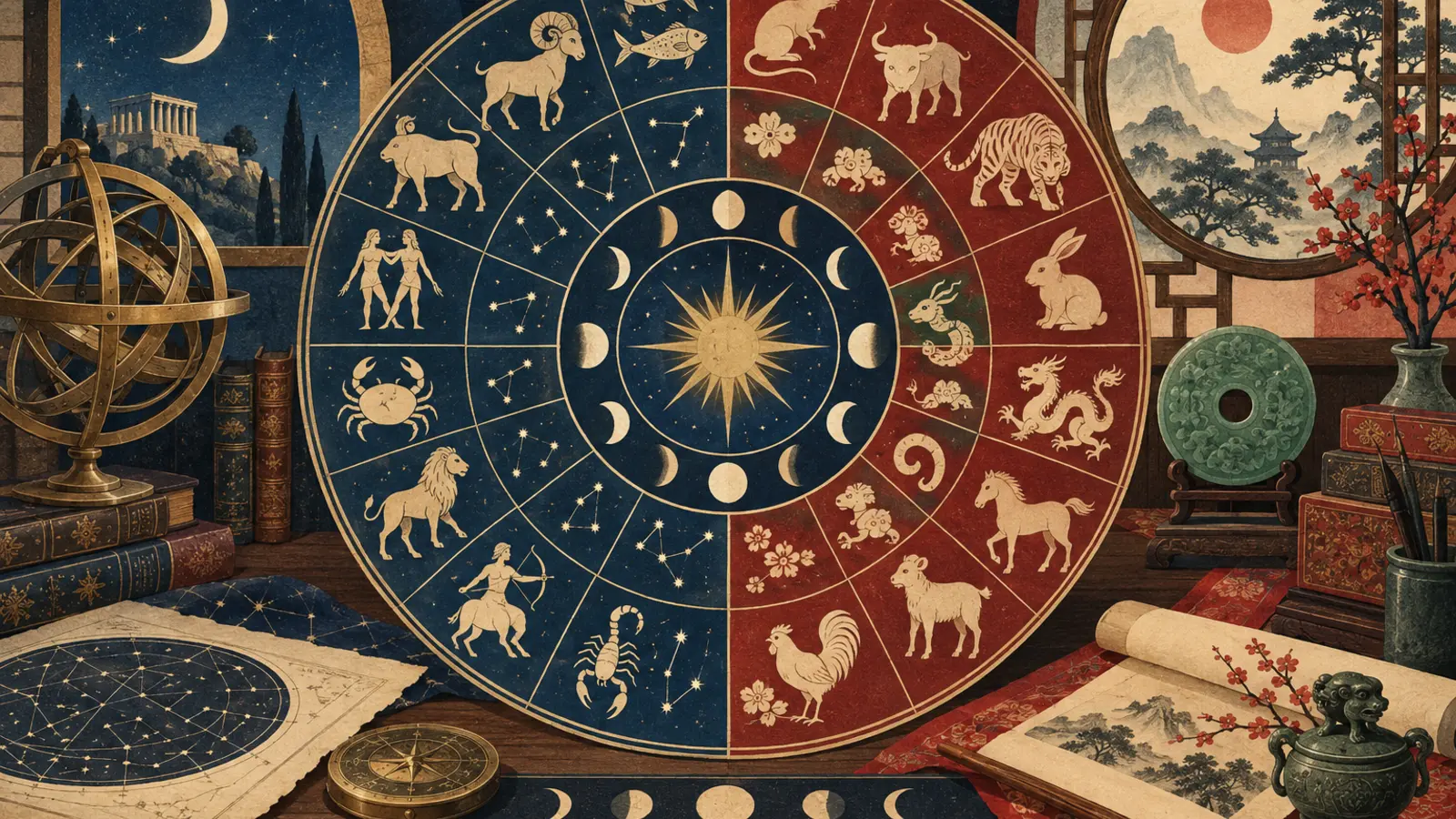
This collection provides educational, literary, and cultural reference materials covering the twelve signs of the Western tropical zodiac and the twelve animal signs of traditional Chinese timekeeping systems. These profiles serve as historical, character-design, and entertainment resources for exploring comparative folklore, seasonal archetypes, and symbolic classifications. Astrological systems have no empirical scientific validity, lack replicable methodological proof, and make no validated predictions concerning personal psychology, biological traits, or prospective life events. Readers should approach all material strictly as an exploration of human narrative heritage and historical calendar symbolism.
Cultural, Literary, and Entertainment Scope
Throughout ancient and pre-modern societies, civil calendars and astronomical observations were closely interwoven with mythological narrative. Celestial configurations provided symbolic frameworks for seasonal agriculture, civic festivals, and allegorical storytelling. In contemporary usage, both Western sun-sign classifications and the Chinese twelve-animal system function predominantly as narrative tropes, recreational personality typologies, and traditional cultural customs. Writers, worldbuilders, and cultural researchers frequently utilize these profiles to establish character temperaments, thematic foils, and allegorical structures. None of the profiles hosted in this directory provide medical, financial, psychological, or predictive life evaluations.
Informational Reference vs. Computational Chart Software
This directory consists exclusively of static, qualitative reference entries. It is neither a dynamic calculation engine nor a personal horoscope generator. Professional and academic practitioners of historical astrology rely on complex computational ephemeris algorithms to calculate precise celestial coordinates. The reference pages in this hub do not perform any of the following computational operations:
- Ephemeris Coordinate Calculations: No automated tracking of planetary longitudes, declinations, lunar phases, or retrograde stations for specific birth epochs.
- Ascendant and House Casting: No calculation of the rising sign (Ascendant), Midheaven (Medium Coeli), or house division systems (such as Placidus, Whole Sign, Koch, Regiomontanus, or Equal House), which require an exact birth hour, minute, and precise geographic latitude and longitude.
- Dynamic Aspects and Transits: No angular relationship calculations (conjunctions, oppositions, trines, squares, or sextiles) between natal positions or real-time celestial bodies.
- Vedic Horoscope Systems: No generation of Indian Jyotish charts, sidereal ayanamshas (such as Lahiri or Raman), Nakshatras, or Dasha timing cycles.
Users seeking basic symbolic classifications, sign dates, traditional elemental groupings, or historical folklore associations can review these profiles directly without creating an account or submitting personal birth data.
Western Tropical Zodiac: Elements, Modalities, and Rulers
Western tropical astrology divides the 360-degree solar ecliptic into twelve standardized 30-degree arcs, beginning at the vernal equinox (zero degrees Aries). This coordinate system is tropical rather than sidereal, meaning it is anchored to Earth's axial tilt and seasonal solstices and equinoxes rather than the visible backdrop of astronomical constellations. Constellations have drifted relative to the equinoxes over millennia due to the precession of the equinoxes (axial precession), creating a divergence between the tropical signs and the physical star constellations bearing the same names.
Profiles such as Aries Zodiac Sign Info, Leo Zodiac Sign Info, and Scorpio Zodiac Sign Info document the classical taxonomy developed throughout Hellenistic, Roman, and medieval European traditions:
- Classical Triplicities (Elements): The twelve signs are grouped into four symbolic elements representing distinct thematic temperaments. Fire signs (Aries, Leo, Sagittarius) are traditionally linked with initiative, vitality, and external expression. Earth signs (Taurus, Virgo, Capricorn) are categorized by material stability, pragmatism, and sensory focus. Air signs (Gemini, Libra, Aquarius) reflect discursive intellect, social exchange, and theoretical abstraction. Water signs (Cancer, Scorpio, Pisces) represent emotional depth, subjective perception, and cyclical renewal.
- Quadruplicities (Modalities): Each element is further expressed across three seasonal stages. Cardinal signs (Aries, Cancer, Libra, Capricorn) coincide with the initiation of astronomical seasons (equinoxes and solstices). Fixed signs (Taurus, Leo, Scorpio, Aquarius) align with the stable midpoints of seasons. Mutable signs (Gemini, Virgo, Sagittarius, Pisces) correspond to the transitional closing periods of seasons.
- Traditional Planetary Rulerships: Classical Hellenistic astrology assigned planetary overseers based on the historic "Thema Mundi" schema, pairing the Sun and Moon with Leo and Cancer, and assigning Mercury, Venus, Mars, Jupiter, and Saturn to the remaining pairs of signs. For example, Mars traditionally governs both Aries and Scorpio, while modern twentieth-century pop-culture variants frequently reassign outer planets (Uranus, Neptune, Pluto) to Aquarius, Pisces, and Scorpio respectively.
- Folklore Compatibility: Traditional texts assess compatibility through geometric harmony along the 360-degree circle. Signs sharing an element form trine aspects (120 degrees apart), while complementary elements (Fire with Air, Earth with Water) form sextile aspects (60 degrees apart). These pairing models are traditional narrative heuristics rather than empirically validated interpersonal metrics.
Western Calendar-Boundary Uncertainty and Solar Ingress
A widespread source of confusion in popular Western astrology is the exact calendar date on which a sign begins and ends. Published magazine columns and digital summaries routinely quote standardized date ranges (for example, assigning Aries to March 21 – April 19). However, because the astronomical tropical year consists of approximately 365.2422 days rather than an even 365 days, the precise moment the Sun crosses zero degrees of a zodiac sign (solar ingress) fluctuates by roughly six hours each year until reset by a Gregorian leap year.
Consequently, an individual born on March 20, March 21, or April 19 may fall under either adjacent sign depending entirely on the specific year, universal time of birth, and local time zone. The popular notion of being born "on the cusp" is an informal cultural idiom; in astronomical and traditional astrological geometry, the Sun occupies exactly one degree and minute at any given moment, never two signs simultaneously. Without dynamic ephemeris software and verified birth times, static calendar tables can only approximate date boundaries.
Chinese Lunisolar Calendar: The 12 Earthly Branches and Cycles
The traditional Chinese zodiac (Shengxiao, meaning "born resembling") operates on an entirely distinct temporal and cultural framework. Rather than dividing the solar path into twelve monthly segments, the Chinese system associates each year in a twelve-year recurring cycle with a symbolic animal archetype. This twelve-year cadence originates from the orbital cycle of Jupiter (historically designated Suixing, the "Year Star"), which completes one revolution around the celestial sphere in approximately 11.86 Earth years.
These twelve animal emblems correspond directly to the twelve Earthly Branches (Di Zhi), an ancient chronological system for recording years, months, double-hours (shichen), and compass directions:
- Rat (Zi): Associated with nocturnal activity, resourcefulness, and the northern direction.
- Ox (Chou): Associated with perseverance, pastoral labor, and foundational stability.
- Tiger (Yin): Documented in reference guides like Year of the Tiger as an archetype of boldness, authority, and volatile energy.
- Rabbit (Mao): Symbolizing gentleness, diplomacy, aesthetic harmony, and lunar folklore.
- Dragon (Chen): Documented in Year of the Dragon Info as the singular mythical creature of the sequence, representing imperial auspiciousness, vitality, and celestial power.
- Snake (Si): Representing introspection, strategic restraint, mystery, and tactical acumen.
- Horse (Wu): Linked to diurnal warmth, boundless mobility, independent enterprise, and rapid travel.
- Goat/Sheep (Wei): Embodying artistic sensibility, communal peace, maternal care, and pastoral serenity.
- Monkey (Shen): Associated with acute intellect, playful invention, verbal agility, and curiosity.
- Rooster (You): Representing vigilance, dawn punctuality, punctilious order, and decisive governance.
- Dog (Xu): Symbolizing communal loyalty, protective vigilance, ethical duty, and steadfast allegiance.
- Pig/Boar (Hai): Representing generosity, unpretentious abundance, good fortune, and domestic goodwill.
Lunisolar Year Boundaries: Civil New Year vs. Solar Terms (Lichun)
Accurate attribution of a Chinese zodiac animal sign requires careful distinction between different calendar frameworks. Because traditional Chinese timekeeping is lunisolar, the start of the civil lunar year (Chinese New Year / Spring Festival) is determined by the second new moon following the winter solstice. As a result, the civil lunar New Year shifts across the Gregorian calendar between January 21 and February 20.
Furthermore, traditional Chinese divinatory disciplines—such as Four Pillars of Destiny (Bazi) and Feng Shui—do not calculate the transition of the annual animal sign according to the civil lunar New Year. Instead, they calculate the annual changeover according to the solar term known as Lichun ("Start of Spring"), which marks the point when the Sun reaches 315 degrees solar longitude, occurring consistently around February 3, 4, or 5 of the Gregorian calendar. A person born in late January or early February may belong to the preceding animal sign according to both civil lunisolar and solar-term reckonings. Users must verify both the lunar phase and the solar calendar context of their birth year rather than assuming the animal changes on January 1.
The Sexagenary Cycle and the Five Phases (Wu Xing)
Beyond the twelve Earthly Branches, traditional Chinese calendar taxonomy pairs the animal signs with the Ten Heavenly Stems (Tian Gan) to form the comprehensive sixty-year sexagenary cycle (Ganzhi). The ten stems embody the Five Phases or Elements (Wu Xing)—Wood, Fire, Earth, Metal, and Water—in alternating Yang and Yin polarities:
- Wood (Mu): Associated with growth, benevolence, spring emergence, and green hues.
- Fire (Huo): Associated with dynamism, illumination, summer heat, and red tones.
- Earth (Tu): Associated with balance, nourishment, seasonal transitions, and yellow/ochre tones.
- Metal (Jin): Associated with refinement, structure, autumn harvest, and white/metallic hues.
- Water (Shui): Associated with wisdom, adaptability, winter storage, and black/dark blue tones.
Each animal sign reappears every twelve years, but it only recurs with the same elemental modifier every sixty years (for instance, a Yang Wood Dragon occurs only once every six decades). The simple sign guides in this directory document the baseline animal archetypes, while historical interpretations incorporate these multifaceted elemental combinations.
Source Divergence and Cross-Cultural Limitations
Neither Western nor Chinese astrology constitutes a monolithic, universally agreed-upon doctrine. Within Western traditions, fundamental schisms exist between Hellenistic whole-sign methods, medieval Arabic-Latin horary techniques, nineteenth-century theosophical reinventions, and twentieth-century psychological archetypes popularized by Carl Jung and modern sun-sign columnists. The planetary rulerships, exalted degrees, and psychological traits asserted in one era frequently conflict with texts written in another.
Similarly, the Shengxiao twelve-animal taxonomy features prominent regional adaptations across East and Southeast Asia. In the Vietnamese zodiac, the Cat replaces the Rabbit, and the Water Buffalo replaces the Ox. In the Nepalese Gurung zodiac, the Garuda replaces the Dragon, and the Deer replaces the Tiger. In Japan, since the adoption of the Gregorian calendar during the Meiji era in 1873, the twelve animal signs are celebrated on solar January 1 rather than the traditional lunisolar festival date.
Comparative Structural Summary
The following table outlines the fundamental structural divergences between the two primary astrological traditions documented across our informational profiles:
| System Attribute | Western Tropical Zodiac | Chinese Shengxiao Zodiac |
|---|---|---|
| Underlying Coordinate Base | Solar ecliptic longitudes (equinoxes and solstices) | Lunisolar calendar years and Jupiter's 11.86-year orbital period |
| Primary Cycle Division | Twelve 30-degree sectors across a single solar year | Twelve repeating year cycles across a sixty-year sexagenary matrix |
| Primary Categorization Metric | Day and month of birth relative to solar ingress | Lunisolar year of birth relative to Lunar New Year or Lichun |
| Constituent Classifications | 4 Classical Elements (Fire, Earth, Air, Water) & 3 Modalities | 5 Phases (Wood, Fire, Earth, Metal, Water) & Yin/Yang polarity |
| Calendar Ingress Sensitivity | Shifts ~6 hours annually; sensitive on boundary days | Shifts between Jan 21–Feb 20; sensitive for Jan/Feb births |
| Empirical Scientific Status | Cultural folklore; zero empirical predictive validity | Cultural folklore; zero empirical predictive validity |
Navigating Related Cultural and Astronomical Resources
Whether examining historical character archetypes for narrative fiction, researching comparative cultural belief systems, or exploring traditional folklore, users are encouraged to cross-reference multiple historical texts. For broader educational exploration into world traditions, astronomical realities, and historical timekeeping frameworks, explore our culture tools, learn about physical celestial bodies through our space tools, or look up cross-disciplinary facts in our curated reference tools.