
















AI Workflow Tools

Compare the best 69 AI Workflow tools by features, pricing, and alternatives.

69 toolsIndependently reviewedFree & paid comparedUpdated Jun 2026

All 69 AI Workflow tools

All AI 3D Model6 AI Ads38 AI Agents29 AI All In One5 AI App2 AI Assistant26 AI Audio15 AI Character2 AI Chatbot10 AI Copywriter4 AI Data27 AI Design53 AI Detector7 AI Document12 AI Education12 AI Email24 AI Language1 AI Music12 AI No-Code/Low-Code21 AI Notetaker30 AI Photo48 AI Presentation7 AI Productivity27 AI Sales16 AI SEO48 AI Social Media22 AI Thumbnail2 AI Tools86 AI Transcription7 AI Translation1 AI Tutor1 AI Video91 AI Voice25 AI Web Scraper2 AI Website Builder16 AI Workflow69 AI Writing46
69 tools Clear ✕
Name Action
Trigger.dev
Open-source background jobs and scheduled tasks with durable execution
Visit
Bench
Managed bookkeeping service for small businesses with AI workflows
Visit
Seamless
The AI sales platform that delivers verified prospects, automated outreach, and the speed your team
Visit
Survicate
A customer survey and AI feedback platform that helps businesses collect insights for improving cust
Visit
Aircall Inc.
Aircall is the intelligent platform for customer conversations
Visit
Pilim
Pilim is an AI powered business management platform for SMEs and enterprises, streamlining
Visit
Treble.ai
Treble users leverage the full potential of WhatsApp with automated interactions, AI chatbots, and o
Visit
Aider
Open-source AI pair programming in the terminal with git integration
Visit
Attentive
AI-powered SMS marketing platform for retail and D2C brands
Visit
Automation Anywhere
AI-powered RPA platform with Automation Co-Pilot
Visit
Braintrust
Evaluation, observability, and data platform for LLM applications
Visit
ConnectWise
Business management and IT automation platform for MSPs
Visit
Datadog
Enterprise observability for cloud infrastructure and applications
Visit
DocuSign
E-signature and agreement management with AI-powered insights
Visit
Findem
AI talent intelligence platform for sourcing and DEI analytics
Visit
Gem
AI sourcing and CRM platform for modern talent acquisition teams
Visit
Humanloop
LLM ops platform for prompts, evals, and fine-tuning workflows
Visit
Inngest
Durable workflow engine for serverless and AI applications
Visit
Ironclad
AI-powered contract lifecycle management for enterprise legal teams
Visit
Kaseya
IT management suite for MSPs with AI-powered automation
Visit
Klarity
AI platform automating accounting, revenue, and procurement operations
Visit
Labelbox
AI data platform for model training, evaluation, and RLHF
Visit
Lever
Talent acquisition platform with ATS and CRM for modern recruiters
Visit
LlamaIndex
Data framework for LLM applications with LlamaCloud enterprise platform
Visit
Prev Page 2 / 3 Next
Buyer's guide

9 Best AI Workflow Tools in 2026: Ranked Guide

Summary

n8n ranks first for technical teams wanting execution-based pricing, deep code customization, and self-hosted control over AI agents. Make leads for visual builders balancing native AI modules with a broad app directory, while Pipedream caters to developers needing code-level API orchestration. Critical update: Relay.app announced its complete shutdown in late 2026, making it unviable for new workflows.

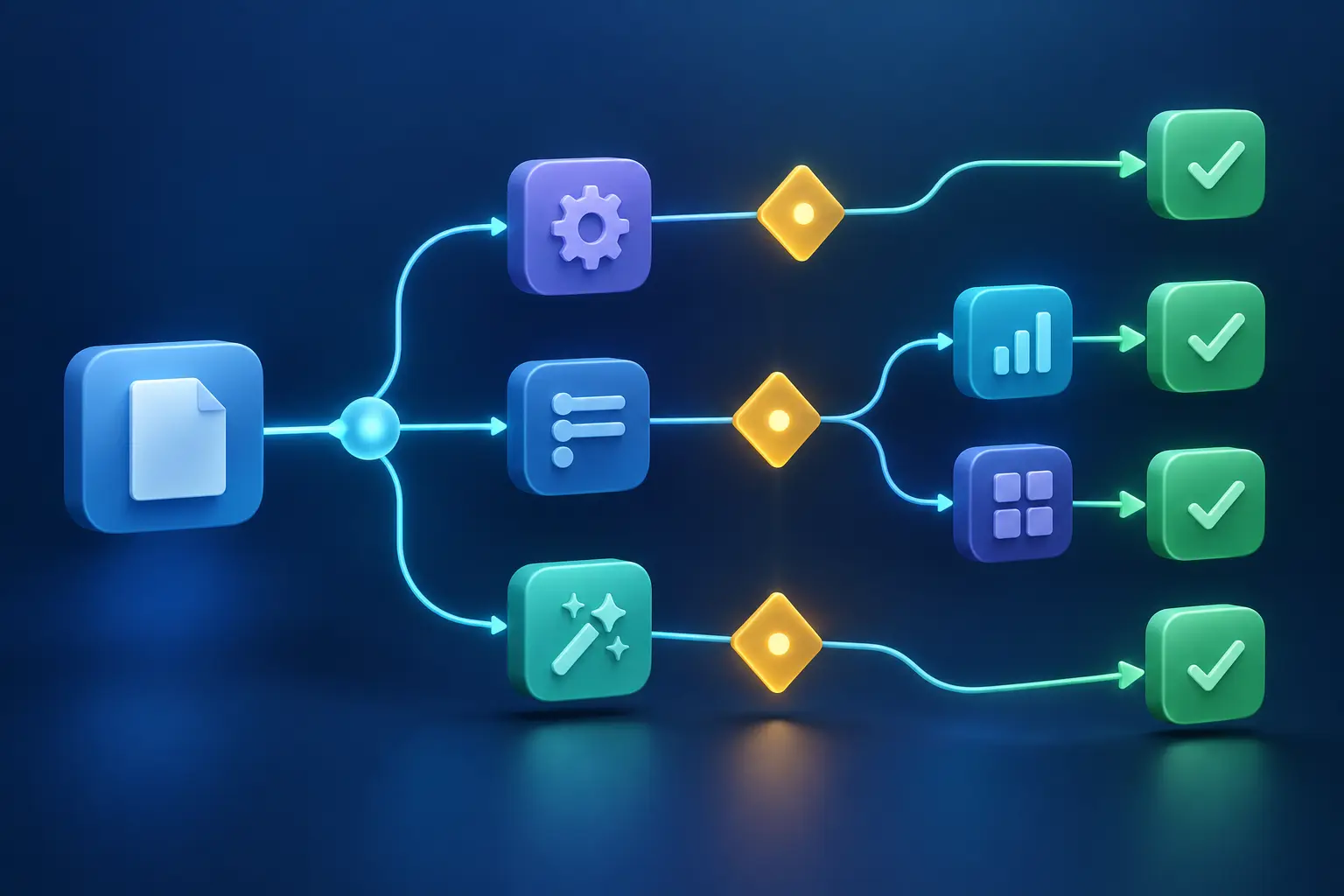
Modular AI workflow branching through transformations and completion checks

Selecting an AI workflow platform in 2026 requires evaluating how execution pipelines handle model autonomy, data security, and recurring run costs. Automation has evolved beyond basic trigger-action app connectors into multi-step pipelines incorporating large language model calls, retrieval-augmented generation (RAG), and Model Context Protocol (MCP) tool integration.

For engineering and technical operations teams requiring complete governance, n8n represents the premier choice. It offers self-hosted deployments, native Python and JavaScript scripting nodes, and predictable billing that charges per full workflow execution rather than per individual action step. Teams seeking visual scenario construction without coding typically gravitate toward Make, which operates on an operations-and-tokens credit structure and supports both native and custom third-party model connections.

Developers needing managed authentication across thousands of APIs find Pipedream best aligned with serverless code workflows, while teams seeking project-native AI agents embedded in workspace tasks are best served by Taskade. Critically, buyers researching Relay.app must note that the service announced a complete operational shutdown effective September 2026, meaning no new implementations should be initiated on that platform.

1
n8n logo
n8n Top pick AI Workflow $20 - $60

The premier workflow automation engine for technical teams, combining self-hosted governance, embedded Python/JavaScript scripting, and cost-effective execution-based billing.n8n is an open-source workflow automation platform engineered to bridge visual scenario building with deep code extensibility. The platform allows users to place native AI agent nodes, RAG architectures, and custom LLM connections directly onto the visual canvas while retaining the ability to write custom JavaScript or Python at any step.A foundational advantage of n8n is its billing philosophy. Unlike conventional platforms that bill for every individual operational step, n8n Cloud plans charge strictly based on complete workflow executions regardless of the internal step count or branching complexity. Official published pricing as of September 2026 lists the Starter tier at 20€ per month (billed annually) for 2,500 executions, 1 shared project, and 2,300 monthly AI credits. The Pro tier is priced at 50€ per month (billed annually) covering 10,000 executions, 3 shared projects, 20 concurrent executions, and up to 13,700 AI credits. For organizations requiring self-hosted collaboration, the Business plan is listed at 667€ per month (billed annually) for 40,000 executions with Git-based version control, SSO (SAML/LDAP), and multi-environment management. A free Community Edition remains available via GitHub for self-hosted deployments.For enterprise and secure environments, n8n Cloud is hosted on Microsoft Azure within the European Union, maintains SOC 2 compliance, supports air-gapped private network installations, and integrates with external secret managers including HashiCorp Vault, AWS Secrets Manager, and 1Password.Not suited for: Non-technical business users seeking purely visual, no-code configuration; Teams unwilling to manage their own infrastructure or JSON payload mapping.


2
Make logo
Make AI Workflow $9 - $34.12

The most versatile visual scenario builder for connecting mainstream apps with AI models, balancing usability with granular credit-and-token execution tracking.Make provides a visual drag-and-drop scenario builder that enables users to link SaaS applications and AI endpoints. Its modular canvas simplifies error handling, router splitting, and payload observation across hundreds of commercial applications.Make organizes platform consumption through a unified currency called credits, which replaced operations as its primary billing unit. Under this architecture, non-AI applications consume 1 credit per operation (such as uploading a file or appending a spreadsheet row). When connecting third-party AI providers like OpenAI, Anthropic Claude, or Google Gemini, Make bills 1 credit per operation, while token costs are paid directly to the model provider on paid plans. Alternatively, when utilizing Make's built-in AI provider or Make AI Agents, credit consumption is dynamic, scaling based on the volume of operations, input file sizes, page counts, and processed token volumes (including embedding tokens for vector retrieval in RAG systems).Make features native Model Context Protocol (MCP) servers and MCP toolboxes, allowing users to expose visual scenarios as executable tools for autonomous AI assistants. The platform also offers Maia by Make, an embedded AI assistant designed to streamline system configuration and scenario generation.Not suited for: Organizations requiring on-premise, self-hosted infrastructure; Workflows with deep programmatic requirements better served by native code environments.

3
Pipedream logo
Pipedream AI Workflow $29 - $74

The developer-first integration runtime that manages auth across thousands of APIs while executing raw serverless code and native MCP endpoints for AI agents.Pipedream serves as an integration backbone for developers building software applications and autonomous AI agents. Rather than forcing users into rigid UI connectors, Pipedream combines pre-built triggers and actions with a serverless execution runtime supporting TypeScript, Python, and Java code blocks.Pipedream manages authorization across more than 3,000 APIs and provides over 10,000 prebuilt tools and triggers via a source-available public component registry on GitHub. For AI agent architectures, Pipedream offers Connect and Conduit gateways, providing a managed remote MCP server endpoint (https://remote.mcp.pipedream.net). Agents connect using standard protocols, automatically discovering tools and executing actions such as customer lookups, database edits, or messaging across user accounts with secure token isolation.The platform offers a free tier (no credit card required) for initial prototyping and workflows, scaling into enterprise-tier infrastructure engineered to handle event pipelines exceeding millions of events per second with custom domains, VPC isolation, and GitHub synchronization.Not suited for: Non-technical operators seeking a no-code visual canvas; Users looking for packaged, pre-built all-in-one business dashboard applications.

4
Taskade logo
Taskade AI Productivity $10 - $100

A unified workspace combining real-time project management, prompt-built software applications, and persistent autonomous AI agents.Taskade approaches AI automation by unifying project collaboration with agent execution. Built on what it defines as "Workspace DNA," the platform organizes operations across three interlocking layers: Projects (memory), AI Agents (intelligence), and Automations (execution). Users can deploy specialized agents trained on uploaded files, web links, and internal project databases to execute recurring tasks autonomously.Published pricing as of September 2026 establishes the entry-level Pro plan at $10 per month (with a 50% discount on yearly billing), including 10 team seats, 50,000 monthly AI credits, unlimited AI apps, unlimited AI agents, unlimited automations, and 100 GB of smart storage. The Business plan is listed at $25 per month, while the Max plan is $100 per month and Enterprise starts at $250 per month. Monthly credit allocations act as a hard ceiling to prevent unintended overages, with optional non-expiring credit packs available for purchase.Security measures include TLS for data in transit, AES-256 encryption for data at rest and backups, workspace isolation with role-based access control, and contractual terms barring AI model vendors from training on user content.Not suited for: Complex enterprise back-end data pipelines spanning deep legacy ERP systems; Developers needing low-level server access or custom containerized self-hosting.

5
Relay.app logo
Relay.app AI Workflow $19 - $86.25

Shutting down operations permanently in September 2026; unviable for new projects, with existing users mandated to export data.Relay.app gained industry attention for combining standard SaaS automation with dedicated human-in-the-loop review steps and collaborative AI checkpoints. However, official announcements confirm that Relay.app has ceased new user acquisition and is shutting down operations completely.According to official shutdown notices dated July 2026, new signups and paid plan upgrades were permanently deactivated on July 16, 2026. Free accounts were scheduled for termination and permanent data deletion on August 15, 2026. Paying customer subscriptions were canceled automatically effective July 16, with prorated refunds processed via Paddle. Access for active paying workspaces was extended on a complimentary basis through September 14, 2026 at 23:59 PT, after which all accounts and associated data will be permanently wiped.Teams with active workflows on Relay.app can export their assets via workspace settings. Supported exports include workflow and sequence structures as JSON files, AI prompts as Markdown (.md) files for re-creation in other engines, run logs as CSVs, and internal tables as CSV files. No new workflow initiatives should be deployed on this service.Not suited for: Any new automation deployment, business process, or team workflow implementation.

6
Pabbly Connect logo
Pabbly Connect AI Workflow $39 - $59

An automation utility offering expansive task allowances and predictable costs for standard multi-app integrations, accompanied by prompt-driven workflow generation.Pabbly Connect provides integration and workflow automation across more than 2,000 applications. Part of the broader Pabbly Plus business management suite, the platform automates data transfers between webhooks, spreadsheets, payment systems, and customer messaging channels.The service introduces Pabbly AgenticAI, enabling operators to assemble automated workflows using natural language prompts (such as generating back-in-stock alerts linking Google Sheets with Pabbly Chatflow). A free plan includes 100 free tasks monthly to test connectivity. On paid plans labeled as "Unlimited," Pabbly applies a documented Fair Usage Policy: accounts receive an initial allocation of 100,000 tasks, which can be manually reset once per day for single-business use. Standalone Pabbly Chatflow subscriptions range from ₹1,499 per month for Standard to ₹6,249 per month for Unlimited (with promotional lifetime tiers available).Infrastructure is hosted on AWS with Cloudflare DDoS mitigation, 128-bit SSL/TLS encryption in transit, AES encryption at rest, and third-party verified SOC 2 Type 2 and ISO 27001:2022 certifications.Not suited for: Teams needing native Python/JS runtime scripting in complex data transformations; Organizations requiring strict containerized on-premise hosting.

7
Albato logo
Albato AI Workflow $13 - $202

A reliable integration platform featuring embedded iPaaS options, a Universal MCP protocol for AI agents, and predictable transaction-tiered pricing.Albato operates as both a standalone workflow automation platform and an embedded iPaaS solution, providing over 1,000 pre-built connectors across CRM, marketing, sales, and operations stacks. The platform supports native AI integration through its Universal MCP layer, enabling autonomous agents to interact with third-party tools via standardized function calls.Albato structures its self-serve plans by monthly transaction volumes (defined as successfully executed automation steps following a trigger). As of September 2026, the Free plan provides 100 transactions, 5 active automations, and 2 steps per automation with 15-minute polling updates. The Pro tier starts at $15 per month billed annually (or $22 per month monthly) for 1,000 transactions, featuring unlimited automations, parallel scenario execution, 5-minute update intervals, and 30-day log retention. The forthcoming Teams tier is listed at $65 per month billed annually ($93 monthly) starting from 5,000 transactions with 5 team seats and 3-minute updates. If an account exhausts its transaction allotment, automations continue executing, with extra transactions billed at $0.0330 each.Albato maintains SOC 2 Type 2 certification, operates multi-zone AWS deployments, and secures credentials using AES-256 encryption with decryption keys held on isolated servers.Not suited for: Self-hosted or private cloud server requirements; Massive-scale developer workflows requiring custom execution environments.

8
TextCortex AI logo
TextCortex AI AI Workflow $29.99

A content and knowledge workflow platform built around custom persona agents, deep research, and direct browser-level automation.TextCortex AI focuses on content generation, document intelligence, and interactive research workflows. Unlike general-purpose iPaaS systems designed to synchronize arbitrary databases, TextCortex functions as an AI productivity workspace that embeds into day-to-day writing and operational tools via browser extensions and dedicated interfaces.The system lets users configure customized AI personas, tap into shared knowledge bases, and utilize agent skills to automate research and text generation. Verified pricing documentation as of September 2026 details a Free plan at $0 per month with access to core features, knowledge bases, custom agents, and up to 50 MB of file storage. The Premium tier is priced at $29.99 per user per month in the captured monthly view, offering access to major foundational models, model usage allowances, image generation, and up to 10 GB of document storage. Enterprise plans utilize customized pricing structures. For developers seeking to deploy its capabilities externally, TextCortex provides a separate API with usage-based token rates.All features on a given license tier are accessible without artificial feature-gating, though total processing remains bound by documented model usage thresholds.Not suited for: General-purpose API orchestration, database synchronization, or complex backend logic; Developer-centric event streaming or infrastructure automation.

9
Boost Space logo
Boost Space AI Workflow $800

An enterprise-grade master data layer and e-commerce agent platform designed to unify fragmented product, catalog, and inventory feeds.Boost.space approaches business automation from the foundational data layer. Positioning itself beneath integration platforms like Make and n8n, Boost.space synchronizes records across 2,675 native integrations to establish a single, two-way master data repository before deploying operational AI agents.Rather than providing generic prompt interfaces, Boost.space deploys pre-configured agents targeting specific catalog and revenue bottlenecks. These include Product Enrichment Agents (standardizing SKU attributes and translations), Supplier Product Listing Agents (cleaning external supplier spreadsheets), Dynamic Pricing Agents (adjusting rates against competitor signals), and GEO Optimization Agents (optimizing product visibility inside AI search engines).Boost.space employs a structured, ROI-contingent sales model. Prospective clients begin with a Free Snapshot assessing catalog health. Formal engagements require a $5,000 fixed-price Blueprint spanning four weeks, which establishes an empirical revenue audit. Platform deployment contracts are priced on a custom, value-based structure scoped to achieve a 5× return threshold. Security credentials include SOC 2 Type 1, ISO 27001, and GDPR compliance.Not suited for: Small businesses or individuals seeking low-cost, lightweight task automations; Teams without dedicated product data operations or sufficient budget for enterprise blueprints.

Evaluation Criteria and Ranking Methodology

This category assessment is based entirely on documented desk research analyzing published vendor documentation, official pricing schedules, security disclosures, and architectural specifications current as of September 2026. No hands-on product testing was performed; rankings reflect use-case alignment, verified documentation rigor, deployment flexibility, and pricing transparency.

Platforms were evaluated against four structural dimensions:

  • Native AI & Agentic Capabilities: Support for multi-agent reasoning, RAG architectures, dynamic model switching, custom prompt orchestration, and standard protocols like MCP.
  • Pricing Architecture & Execution Transparency: Predictability of cost models (execution-based versus step/credit-based meters, concurrency limits, and token pass-through charges).
  • Developer & Extensibility Controls: Availability of custom code blocks (JavaScript/Python), raw webhook handling, custom API connectors, and source availability.
  • Security, Compliance & Data Governance: Verification of independent security audits (SOC 2, ISO 27001), encryption standards (AES-256, TLS), and on-premise or self-hosting deployment options.

AI Workflow Automation Tools: Architectural Comparison

PlatformEntry Pricing (Published)Primary AI CapabilitiesIntegration FootprintHosting / Security
n8n20€/mo (Starter, billed annually) or Free self-hostedNative AI agent nodes, RAG setups, MCP support, multi-agent chains500+ pre-built nodes, custom API/cURLCloud (Azure EU) or Self-hosted (Docker/K8s); SOC 2
MakeCredit-based tiers; cost varies by planMake AI Agents, Maia, MCP servers, OpenAI/Claude/Gemini modules1,500+ apps and modular connectorsManaged Cloud; fixed/dynamic token credit billing
PipedreamFree tier available; usage-scaled pricingManaged MCP endpoints, agent tool discovery, proxy routing3,000+ APIs, 10,000+ prebuilt toolsManaged serverless runtime; SOC 2 controls
Taskade$10/mo (Pro, billed annually or monthly promo)Workspace DNA agents, Taskade EVE, custom agent tools, prompt-to-app100+ standard app connectionsCloud; AES-256, TLS, SOC 2 in progress
Relay.appService winding down; subscriptions canceledHuman-in-the-loop approvals, MCP server exportsSaaS integrations (exporting data available)Platform terminating operations September 2026
Pabbly ConnectIncluded in bundle/tier plans (Free tier: 100 tasks/mo)Pabbly AgenticAI, prompt-based automated workflow generator2,000+ integrated servicesCloud (AWS); SOC 2 Type 2, ISO 27001:2022
Albato$15/mo (Pro billed annually, 1K transactions)Universal MCP, AI Agents, Albato Copilot, natural language builder1,000+ native connectorsCloud (AWS multi-zone); SOC 2 Type 2
TextCortex AI$29.99/user/mo (Premium, monthly billing)Custom AI personas, agent skills, knowledge bases, deep researchBrowser-wide integration, productivity toolsCloud; documented model usage limits
Boost.space$5,000 fixed Blueprint; value-based platform pricingE-commerce AI agents (Dynamic Pricing, Product Enrichment)2,675 native integrations (two-way sync)Cloud; SOC 2 Type 1, ISO 27001, GDPR

How to Select the Right AI Workflow Platform

When choosing an automation system to handle AI-augmented business processes, evaluate platforms against specific structural operational constraints:

  1. Execution Model vs. Step Billing: Platforms like n8n charge per complete workflow run regardless of internal node complexity. In contrast, platforms like Make or Albato meter by operations, transactions, or token consumption. If your automated flow involves multi-step loops or verbose agent reasoning, execution-based billing prevents exponential cost spikes.
  2. Code Extensibility: Determine whether your pipelines require data shaping beyond visual drag-and-drop mappers. Teams needing custom npm libraries, Python dataframes, or bespoke transformations will benefit from n8n or Pipedream, while non-technical operators will move faster inside Make or Albato.
  3. Model Flexibility and Token Billing: Make and Taskade permit plugging in custom API keys from providers like OpenAI and Anthropic Claude, decoupling task execution fees from direct token usage. Verify whether the tool mandates proprietary AI credits or lets you supply private API keys.
  4. Data Residency and Air-Gapped Operation: If processing regulated customer records or proprietary intelligence, confirm self-hosting viability. n8n offers full containerized deployments on Docker and Kubernetes with private secret management, whereas platforms like Albato and Taskade operate purely as multi-tenant managed cloud infrastructure.

Platform Limitations, Caveats, and Vendor Vulnerabilities

Evaluating automation software requires recognizing operational boundaries and commercial realities:

  • Service Longevity Risks: Cloud-only micro-platforms carry ongoing business continuity risk. Relay.app demonstrated this vulnerability by announcing a complete operational sunset in 2026, forcing active users to export workflows and reconstruct logic elsewhere.
  • Token and Execution Overage Costs: Dynamic AI features introduce non-deterministic billing. On platforms using transaction or credit metering, like Make and Albato, high-frequency agent tool calls can rapidly consume monthly allotments, triggering automatic overage rates (e.g., $0.0330 per extra transaction on Albato).
  • Scope and Focus Divergence: Tools such as TextCortex AI focus strictly on content creation, persona generation, and text workflows, lacking general API orchestration. Conversely, Boost.space requires a substantial upfront financial commitment ($5,000 Blueprint) specifically tuned for master catalog synchronization rather than general-purpose app wiring.

Frequently asked questions

What is the primary difference between n8n and Make regarding AI workflow costs?

n8n bills primarily based on full workflow executions regardless of the number of internal steps or logic branches, and offers a free, self-hosted Community Edition. In contrast, Make meters usage via credits and operations, where third-party AI calls consume operations while token volumes are billed either dynamically via Make's AI provider or directly through connected API keys (such as OpenAI or Anthropic).

Is Relay.app still an option for building new AI workflows?

No. Relay.app officially announced its shutdown in July 2026. New signups and plan upgrades were permanently disabled on July 16, 2026. Free accounts were scheduled for deletion on August 15, 2026, and access for paying customers ended on September 14, 2026, after which all customer accounts and data are permanently deleted.

How does Pipedream handle AI agent authentication across external tools?

Pipedream provides a managed authentication layer across more than 3,000 APIs. Developers can connect AI agents using its remote Model Context Protocol (MCP) server endpoint, which automatically handles OAuth token storage, credential refresh, and per-user authorization without exposing API keys to client-side code.

Can I run autonomous AI workflows completely on-premise?

Yes. n8n offers full self-hosting capabilities using Docker or Kubernetes containers under its fair-code license. This allows organizations to keep execution logs, credentials, and data pipelines on their own private servers or within air-gapped network environments.

What security standards govern AI workflow platforms?

Leading platforms maintain external compliance certifications. For example, Pabbly Connect and Albato hold SOC 2 Type 2 certifications; Boost.space is ISO 27001 certified and SOC 2 Type 1 compliant; and n8n maintains continuous SOC 2 alignment with Azure-hosted infrastructure in the EU.